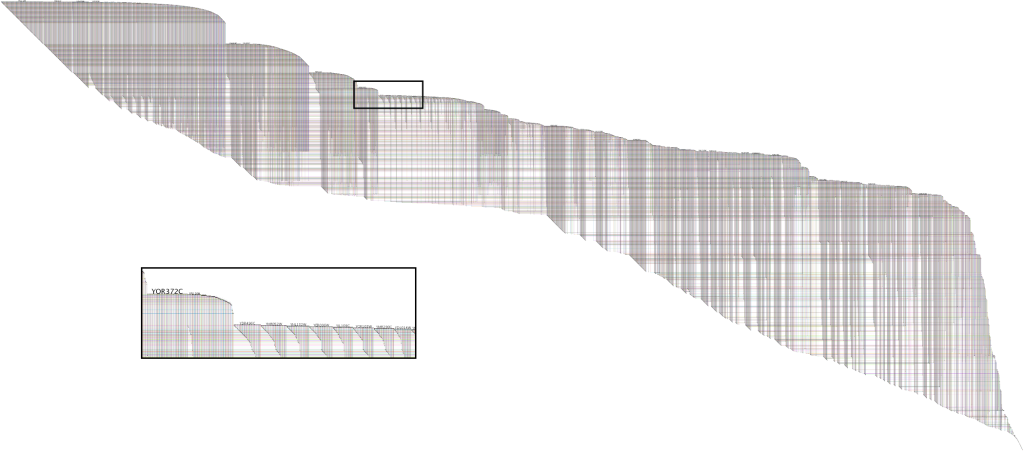
BioFabric is a network visualization method that represents nodes as horizontal lines and edges as short vertical marks crossing those lines. This differs from conventional node-link diagrams and can make large networks more orderly.

Purpose
The purpose is to avoid node overlap and tangled links in large networks. By turning nodes into lines, BioFabric gives every node a visible row and every edge a position.
Design Notes
- Ordering of nodes and edges is critical.
- Use interaction to inspect details.
- Explain the unfamiliar encoding to readers.
- Consider it for large networks where node-link diagrams become unreadable.
Summary
BioFabric is a distinctive alternative to node-link diagrams. It can reveal structure in large networks by trading familiar geometry for a more scalable tabular-like layout.