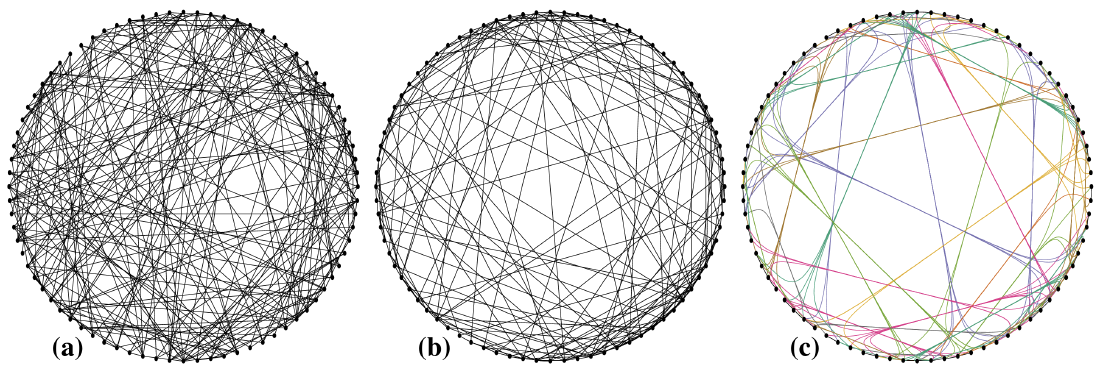
A circular layout places network nodes at equal intervals around a circle. It is useful when node position has no inherent spatial meaning and the goal is to show the overall structure simply.

Use Cases
- Small network overviews
- Comparing connection patterns around a fixed ordering
- Teaching graph structure
- Layouts supported by tools such as NetworkX
Design Notes
- Choose node order carefully; it strongly affects edge crossings.
- Avoid very dense networks.
- Use color or grouping to support interpretation.
- Consider chord diagrams when edge volume matters.
Summary
Circular layouts are simple and orderly. They work best when the circular arrangement itself supports reading the network.