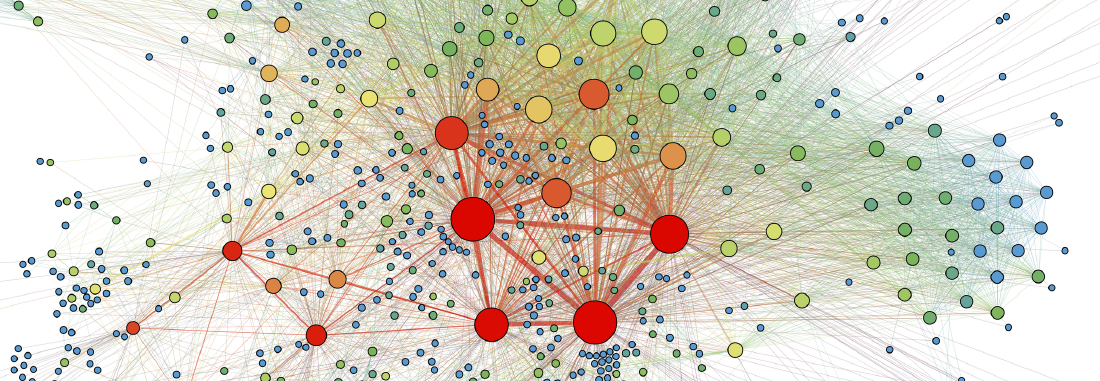
A force-directed diagram is a network layout method that positions nodes and edges through simulated physical forces. Nodes repel one another, while edges act like springs that pull connected nodes together. The layout settles into a balanced configuration that can reveal clusters and relationships.
Use Cases
- Social networks
- Web link structures
- Biological interaction networks
- Knowledge graphs
- Organizational relationship maps
Design Notes
- Use interaction for large networks.
- Avoid treating distance as exact unless the layout defines it.
- Label only important nodes in dense diagrams.
- Consider adjacency matrices or hive plots when comparison and structure matter more than organic layout.
Summary
Force-directed diagrams are intuitive for exploring network structure, especially clusters and connected groups. Their apparent geometry is generated by layout rules, so it should be interpreted carefully.