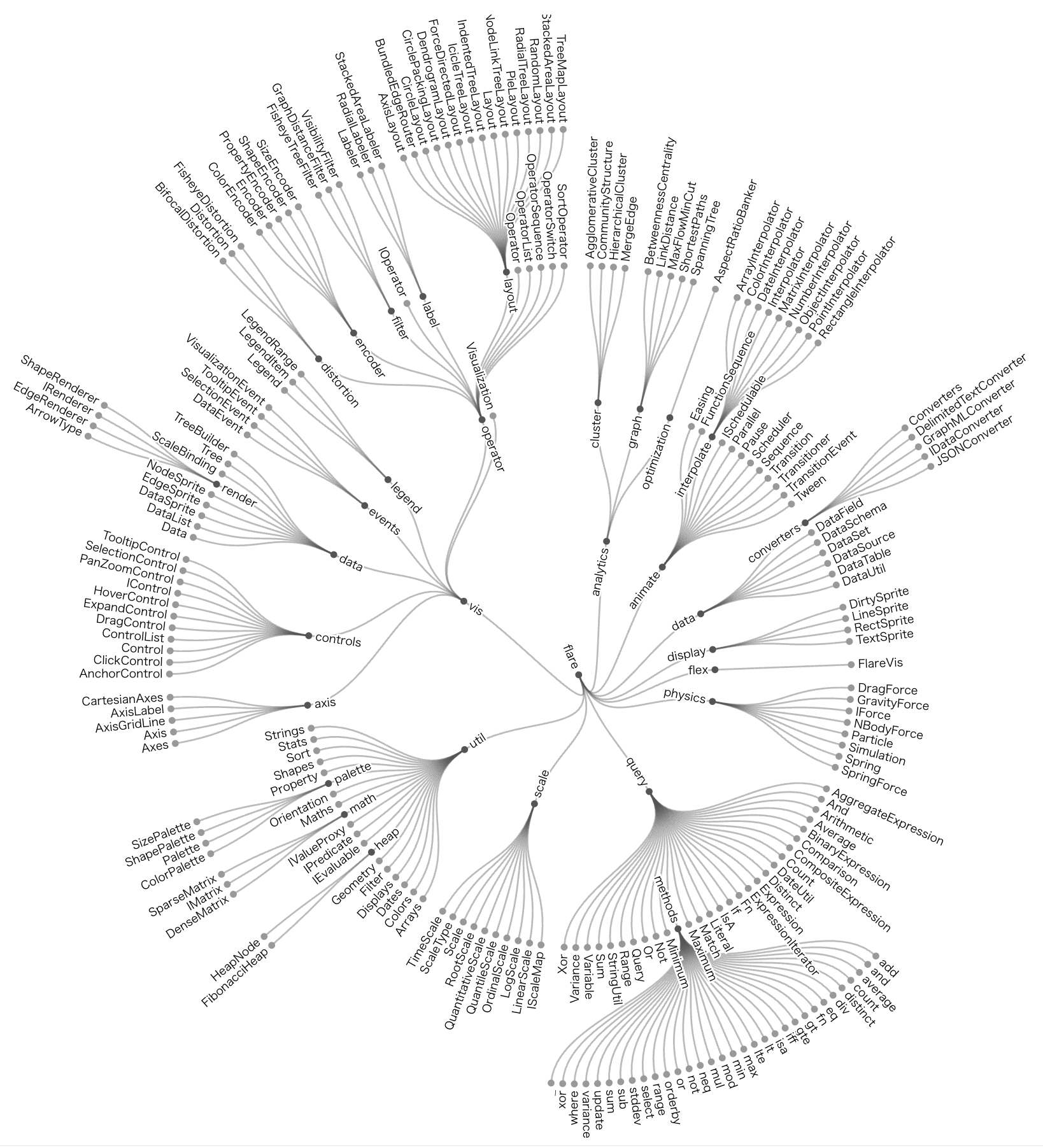
A radial tree lays out a hierarchy in a circular form. The root node is placed at the center, and child nodes radiate outward by level. This makes hierarchical depth and parent-child relationships visible in a compact layout.
Historical Background
Circular tree layouts appear in nineteenth-century classification and phylogenetic diagrams, but computational radial tree layouts developed in information visualization research in the late twentieth century.
Use Cases
- Taxonomies
- Organization structures
- File systems
- Phylogenetic trees
- Information architecture maps
Design Notes
- Use radial trees when compact overview matters.
- Keep labels legible around the circle.
- Avoid very deep hierarchies without interaction.
- Consider horizontal trees when labels are long.
Summary
Radial trees are compact hierarchy diagrams. They provide a strong overview, but label readability and dense branches require care.