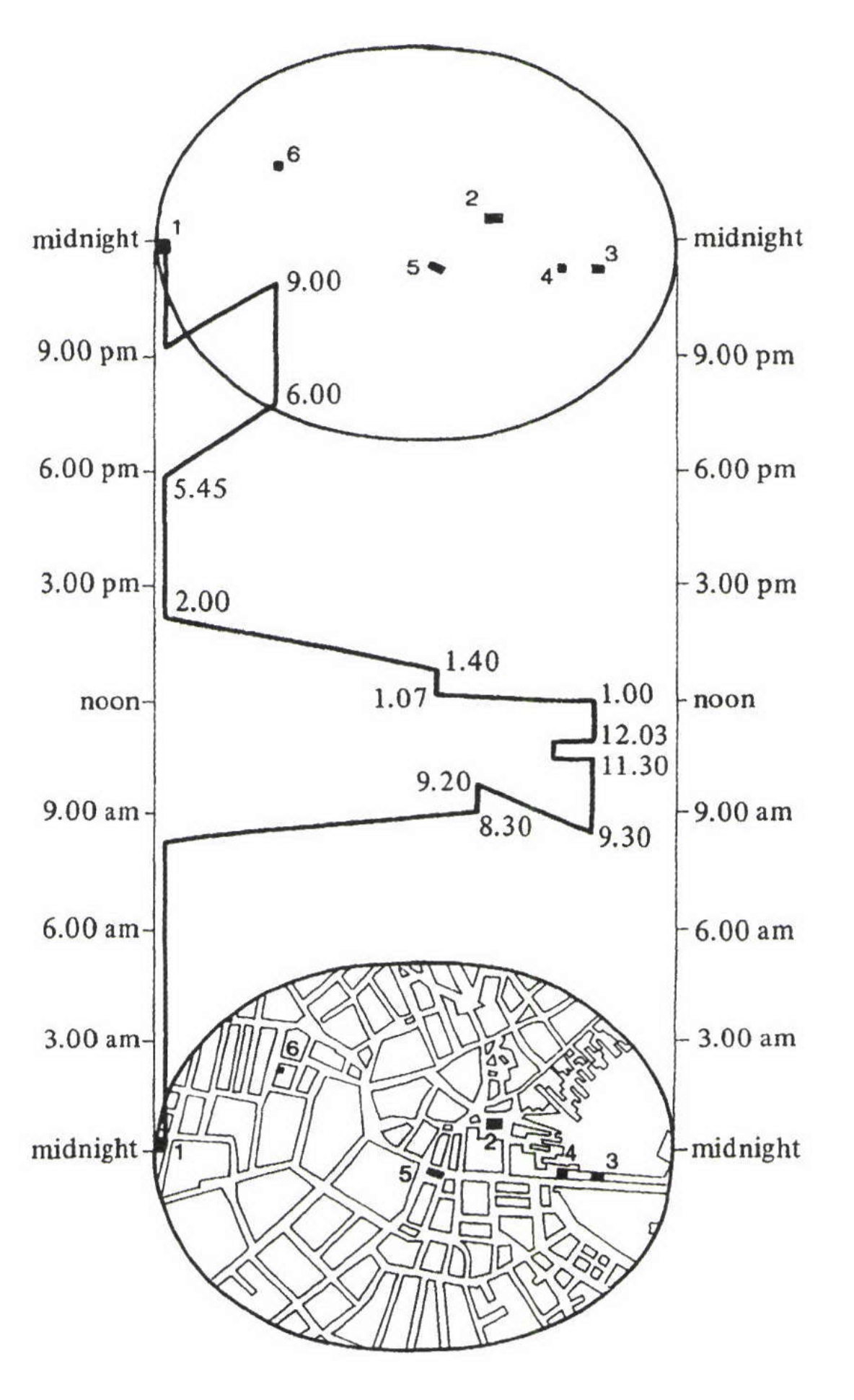
This diagram appeared in geographer Allan Pred’s 1984 paper “Structuration, Biography Formation, and Knowledge: Observations on Port Growth during the Late Mercantile Period.” It shows how a late eighteenth-century Boston merchant spent a day across both time and space.
It is an important example of visualizing the relationship between human action and urban space in the context of structuration theory.
How to Read It
The diagram treats a person’s daily movement as a path through time and space. Time is not separated from geography; instead, movement, duration, and location are combined into one visual structure.
Why It Matters
The work demonstrates that daily life can be understood as a spatial-temporal pattern. It connects biography, social structure, and urban geography.
Summary
The space-time path diagram is a powerful way to show lived movement. It makes visible how people occupy cities not only as points on a map, but as sequences of actions through time.