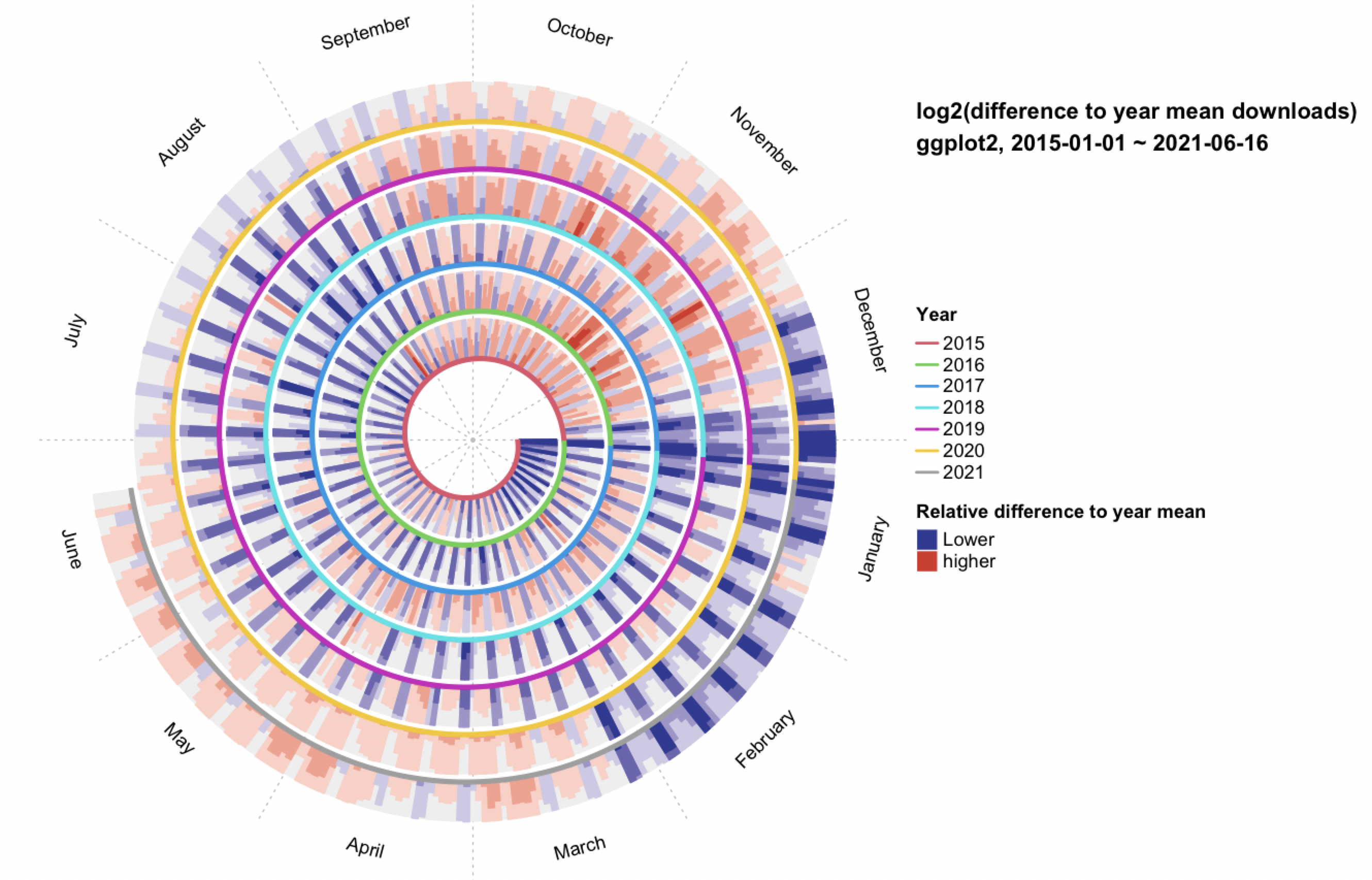
A spiral chart represents time or cyclical change along a spiral path. Unlike a circular chart that completes in one loop, a spiral can wind continuously through multiple cycles, making seasonal and periodic patterns easier to compare across years or periods.
Historical Background
Spiral forms in information graphics date back to nineteenth-century statistical diagrams. They are conceptually related to polar charts and cyclical time representations.
Use Cases
- Seasonal time series
- Daily, weekly, or yearly cycles
- Long time series with repeated periods
- Periodic environmental or social data
Design Notes
- Make the time direction clear.
- Avoid using spiral form when linear time comparison is simpler.
- Label cycles or reference periods.
- Use color carefully to avoid confusing position and value.
Summary
Spiral charts are useful when periodicity is central to the story. They make repeated cycles visible, but they can be harder to read precisely than linear time-series charts.