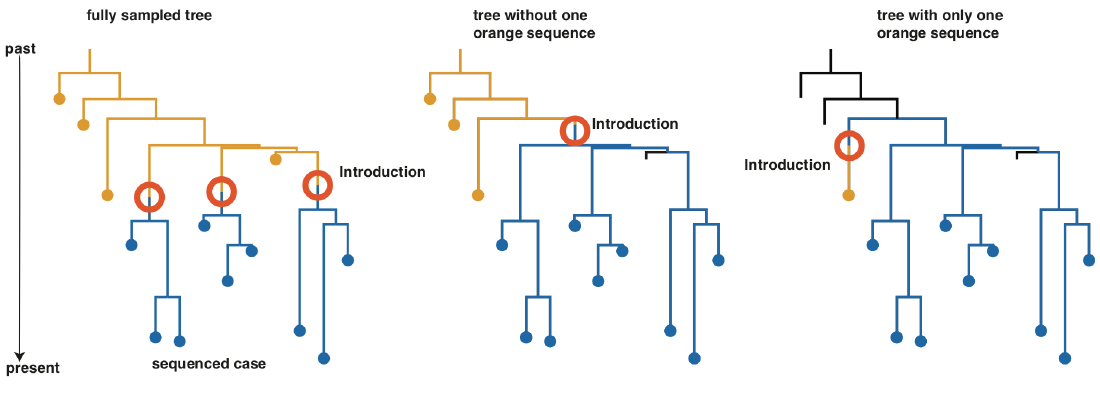
A time-series linear dendrogram unfolds hierarchical relationships along a time axis. Whereas ordinary dendrograms mainly show spatial hierarchy, the linear time-series form shows when and how branches diverge or emerge.
Historical Background
Dendrograms developed from biological classification and later became standard in hierarchical clustering. Time-aware linear dendrograms are especially important in phylogenetics, where mutations and lineages must be understood over time. Platforms such as Nextstrain made this form widely visible during the COVID-19 pandemic.
Data Structure
| Data | Role |
|---|---|
| Node | Ancestor, group, or cluster |
| Branch | Relationship or divergence |
| Time | Position along the timeline |
| Metadata | Optional color or annotation |
Purpose
The purpose is to show hierarchical branching together with temporal sequence. It answers not only what is related to what, but when divergence occurred.
Design Notes
- Make the time axis clear.
- Use color for meaningful lineage or category metadata.
- Avoid overloading the chart with too many labels.
- Provide interaction for dense trees.
Summary
Time-series linear dendrograms are useful when hierarchy and time are inseparable. They are especially powerful for evolution, lineage tracking, and historical branching processes.