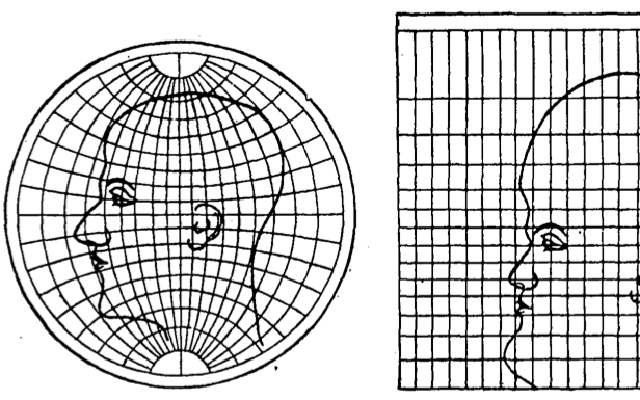
Every map projection creates distortion because the spherical Earth must be represented on a flat plane. Tissot’s indicatrix is a method for showing that distortion quantitatively and visually.
Basic Principle
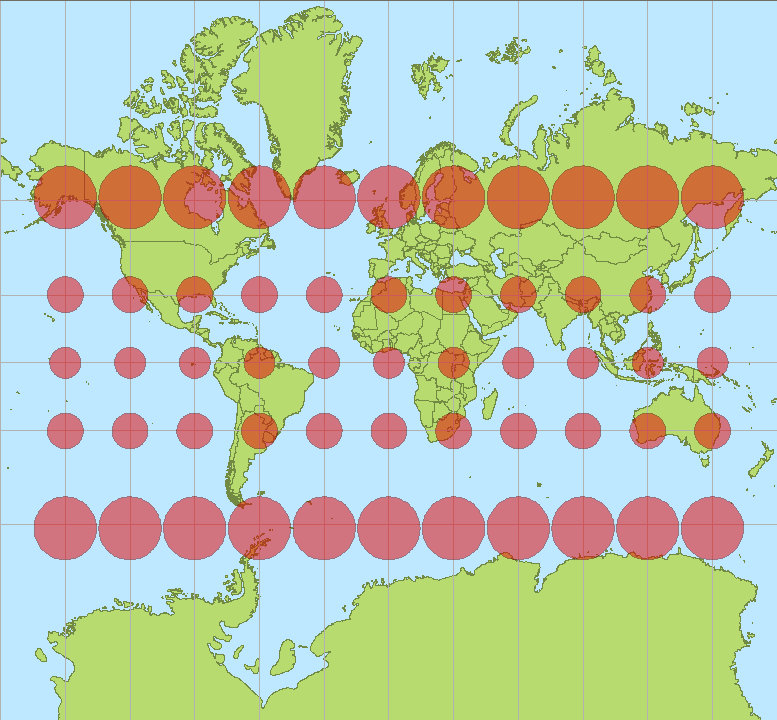
French cartographer Nicolas Auguste Tissot introduced the method in 1871. Imagine placing many tiny circles on the globe. When a projection transforms the globe onto a plane, those circles may become ellipses.
If a projection were perfectly accurate everywhere, all circles would remain circles. In reality, the size, shape, and orientation of the ellipses reveal how area, angle, and scale are distorted.
How to Read It
- A larger ellipse indicates area enlargement.
- A smaller ellipse indicates area reduction.
- An ellipse stretched in one direction indicates directional distortion.
- A circle suggests local shape preservation.
Why It Matters
Tissot’s indicatrix makes projection distortion visible. It helps readers understand that map projections do not merely change appearance; they change measurable properties of geography.
Summary
Tissot’s indicatrix is one of the clearest tools for teaching projection distortion. By turning abstract mathematical distortion into visible ellipses, it helps explain why no flat map can preserve everything.