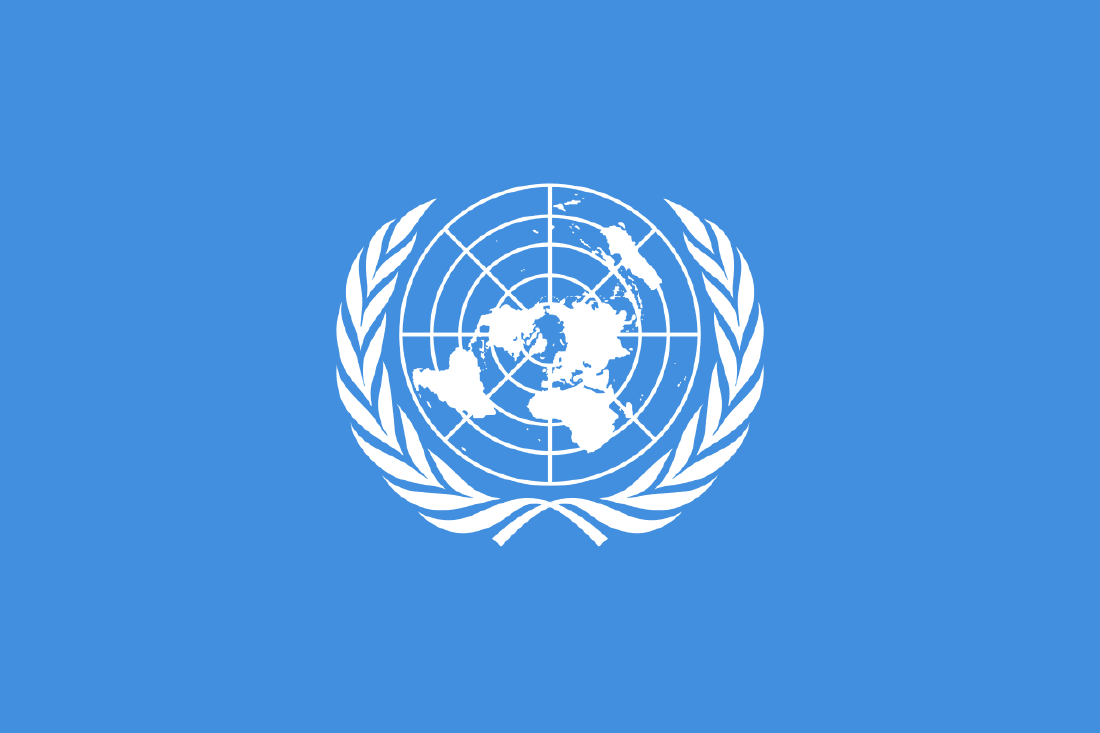
The United Nations flag shows the UN emblem in white on a pale blue background. At the center is a map of the Earth surrounded by olive branches. This article introduces the map projection used in that emblem and its symbolic meaning.
How to Read the Map
The map on the flag uses an azimuthal equidistant projection centered on the North Pole. The projection shows the world as if viewed from above the pole, extending to 60 degrees south latitude and including concentric circles.
This arrangement places countries around the center without emphasizing one nation as the visual focus. The projection supports the UN’s image of universality and neutrality.
What Is an Azimuthal Equidistant Projection?
An azimuthal equidistant projection maps the Earth from a chosen center point so that distances and directions from that center are preserved. It has been used for aviation, communications, and other applications where distance or direction from a point matters.
On the UN flag, the North Pole center creates a symbolic overhead view of the world. No country is placed at the conventional center of a world map, and the design avoids privileging a single region.
Summary
The UN flag’s map projection is a design choice with symbolic force. The azimuthal equidistant projection supports an image of global inclusiveness and political neutrality.