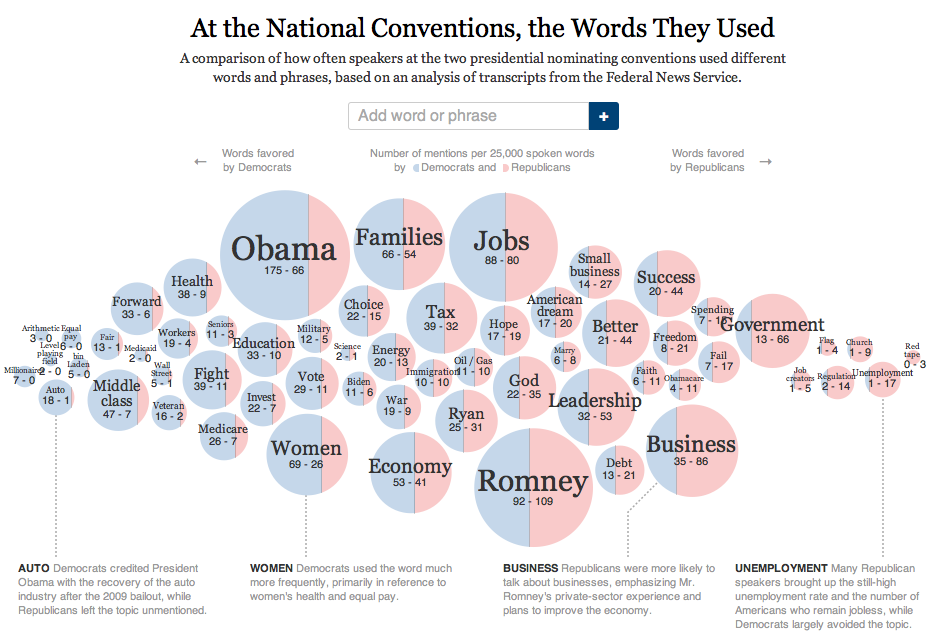
A word bubble chart represents words from text data as circles. The size and color of each bubble can encode frequency, importance, category, or sentiment. It resembles a word cloud, but avoids overlapping words and can provide a clearer layout and stronger sense of relative structure. It is often used to communicate results from natural language processing and text mining.
Historical Background
Word bubbles emerged as a more structured extension of word clouds. From the 2010s onward, implementations appeared in visualization tools and D3.js examples under names such as word bubble chart or bubble cloud. The method became useful in data journalism, education, marketing, and survey analysis because it combines visual appeal with clearer comparison.
Data Structure
| Field | Example | Description |
|---|---|---|
word | “data” | Word to display |
frequency | 120 | Count or score |
category | “technology” | Optional topic or group |
Bubble size is usually determined by frequency, while color often represents category or sentiment.
Purpose
The purpose is to make important or characteristic words in a text collection visible at a glance. Because relative frequency can be compared visually, the method is useful for presenting quantitative text analysis in an intuitive way.
Use Cases
- Sentiment analysis of social media and reviews
- Summaries of free-text survey responses
- Keyword analysis of speeches and articles
- Brand and product language analysis
- Vocabulary exploration in education
Characteristics
- More structured than a word cloud because overlaps are avoided.
- Size and color can encode multiple dimensions.
- Interactive tooltips and clicks can show details.
- It can balance visual appeal and readability when the word count is controlled.
How to Read It
- Bubble size shows word frequency or score.
- Bubble color often shows sentiment or category.
- Placement may reflect frequency, semantic grouping, or clustering.
- Labels identify the words and make comparison possible.
Design Notes
- Do not show too many words.
- Use appropriate scaling so smaller terms remain readable.
- Choose colors for category distinction and accessibility.
- Avoid random-looking layouts when semantic or frequency structure matters.
Alternatives
| Method | Feature | Suitable when |
|---|---|---|
| Word cloud | Quick overall impression | You want a broad textual impression |
| Heatmap | Precise value comparison | Quantitative differences matter |
| Network diagram | Shows relationships | Co-occurrence and context matter |
| Circle packing | Preserves hierarchy | Words are grouped by categories |
Summary
Word bubbles are a structured way to visualize important words in text data. Compared with word clouds, they provide better layout control and comparison, making them useful for journalism, education, marketing, and text analytics.